
Okay, I’m indulging in too much knowledge of horses and an urge to do math here.
“Morgenstern was six hands higher than any other horse I’d ever seen…” -Corwin (NPiA, ch. 4)
So how tall IS Morgenstern?
It depends entirely on the height of the tallest horse Corwin’s seen, and whether he was talking Earth horses or not. Let’s assume he was talking horses here on Earth; otherwise, there’s no basis to even make a guess.
The two tallest horses on record are 21.2 hands (about 7′ 2″, recorded in 1846; I’m not sure of the veracity of that particular record, since I can’t get my hands on a Guinness reference) and 19.115 hands (about 6′ 5″, recorded in the Guinness Book of Records). If Corwin saw either of these horses, it would put Morgenstern in the 25 to 27 hand height – 8′ 4″ to 9′ 0″ tall at the shoulder.
But what if he didn’t?
In that case we turn to the tallest breed of horse – the Shire. Shire horses stand taller than 16.2 hands (5′ 6″) and can be over 18 (6′ 0″) hands high. The 19.115 hand horse mentioned before was a Shire, so they’re generally under 19 hands (6′ 4″) high. Let’s assume, therefore, that the tallest horse Corwin likely saw was 18 to 19 hands high. That makes Morgenstern somewhere between 24 and 25 hands high – 8′ 0″ to 8′ 4″ at the shoulder.
Assuming Corwin was using Earth as a reference, we can probably guess that Morgenstern is 8 to 9 feet high. That is a ridiculous amount of horse.
So the next question would be how much Morgenstern weighs (well, it is for me…). I’m assuming that he’s built like a light horse – a Thoroughbred, for instance – instead of a heavy horse like a Clydesdale. I’m making this assumption based on the fact that he’s a high-speed horse, which heavy horses tend not to be; given that Julian uses him for hunting, he is also at least an adequate jumper, again something heavy horses tend to not engage in. Morgenstern is of sufficient height (as already established) that if Julian wants to engage in knightly pursuits, a heavy charger-style build is entirely unnecessary. Probably the best analogue for what I’m thinking of is a warmblooded horse like a Holsteiner:
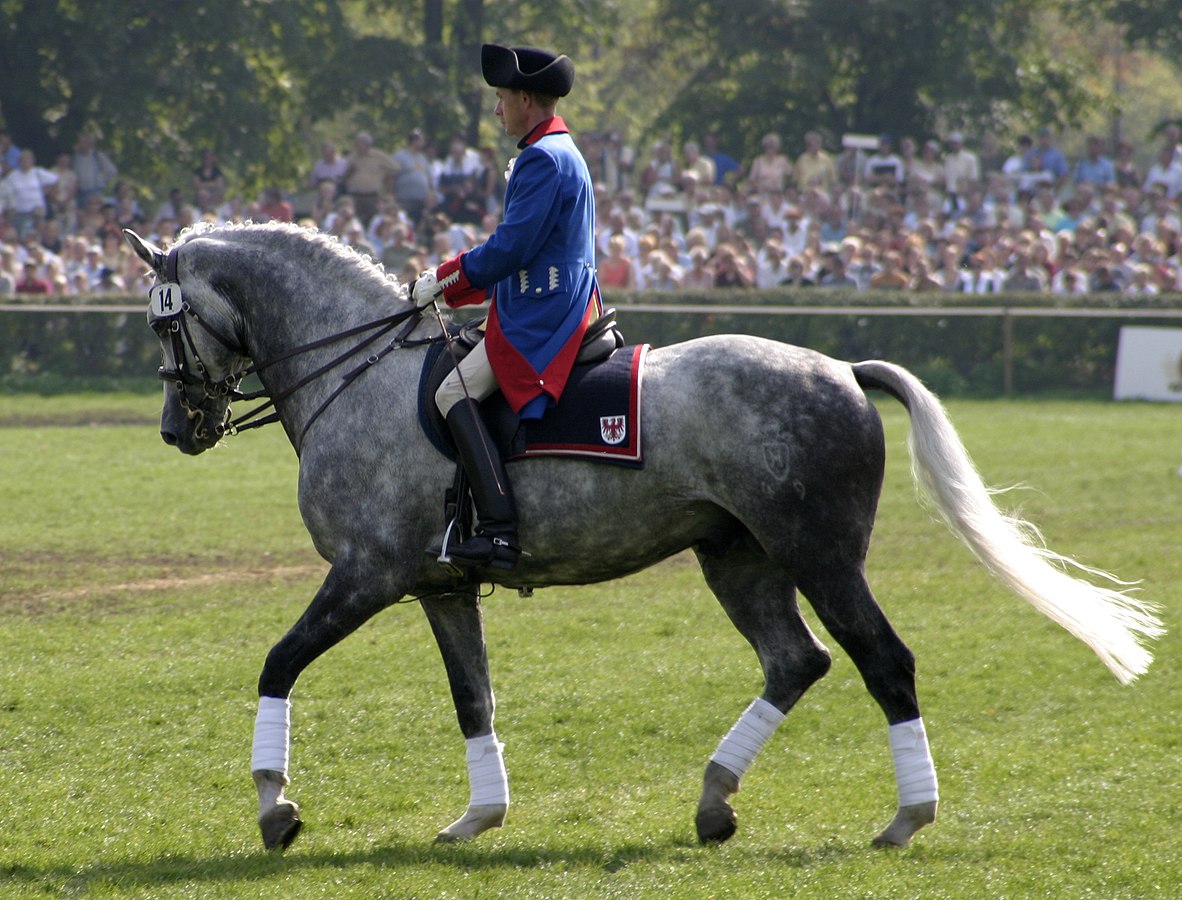
By Alexander Kastler – Own work, CC BY-SA 2.5, Link
Or a Trakhener:
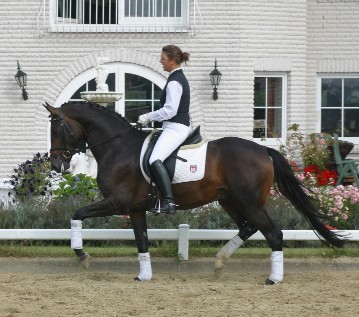
By Kleopatra4, CC BY-SA 3.0, Link
Something with the versatility of a light, hot-blooded horse (again, like a Thoroughbred) and the toughness and sturdy build of a heavy, cold-blooded horse (like the Shire or Clydesdale). (And I’m using terms like “light horse” and “hot-blooded” kind of loosely here – for an explanation, go here.)
Okay, at this point I have to go really esoteric here, so bear with me. Normally, a horse’s weight is estimated using a tape measure to measure the heartgirth (the circumference of the chest right behind the highest point of the shoulders and the elbow) and then comparing that measurement to a chart of weights. Obviously, we can’t do that in Morgenstern’s case. I only found one method of measurement that allowed one to take the height and guess the weight. It also requires a measurement of the horse’s physical condition (described here). The final guess, expanding the chart from method one of this page into this chart:
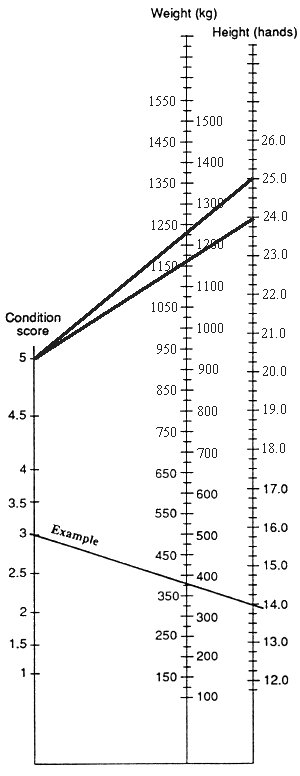
Leads me to suggest that Morgenstern would weigh at least 1150 pounds. Shire horses average around 2200 pounds; since they’re heavy horses, I hesitate to suggest that Morgenstern would be in quite the same weight class, but that might be an upper-end weight. So call him at least 1150 to 2200 pounds – around a ton of horse.
Okay, I’m finished being completely esoteric.
Looking at that again, I think my estimate for Morgenstern’s weight is WAY conservative. I just found records on Man O’War that indicate he stood 16.2 hands and weighted 1125 pounds. So I should probably revise my statement to an estimate of 1500 to 2500 pounds, at least, and possibly more.
Now on to something else that I’ve been wondering about: the kind of speed Morgenstern can produce. Corwin states that the car is traveling at around 75 mph at the point Morgenstern catches up with them – and since the horse tosses his head, I can’t believe that he’s at full speed. If you watch horses at a gallop with riders on their backs (say, in a race, or a steeplechase, or barrel racing), they never toss their heads if they’re running all-out. Random mentions that Julian was playing with them… so I doubt he was pushing for speed anyway; he had to know that the hairpin turns in the road were approaching, so there was no reason to contest the car in a straightaway. I’m going to come back to this in a moment…
Let me go a little father afield here and look at stride length.
I looked up some things first. According to this .pdf (lost link), horses tend to have an average stride length of 19.5 to 22.5 feet. Average horse height is around 15.1 to 15.2 hands (5′ 1″ to 5′ 2″). To give myself a few more points, I looked at the Thoroughbred racehorses Man O’War (1917-1947; stride length is 28 feet; height as three-year-old was 16.2 hands) and Secretariat (1970-1989; stride length approx. 24 feet [inferred from
this picture, where the red/white pole farthest to the right is Man O’War’s 28-foot stride and Secretariat’s stride is marked by the red/white pole farthest to the left]; height as two-year-old was 16.025 hands):
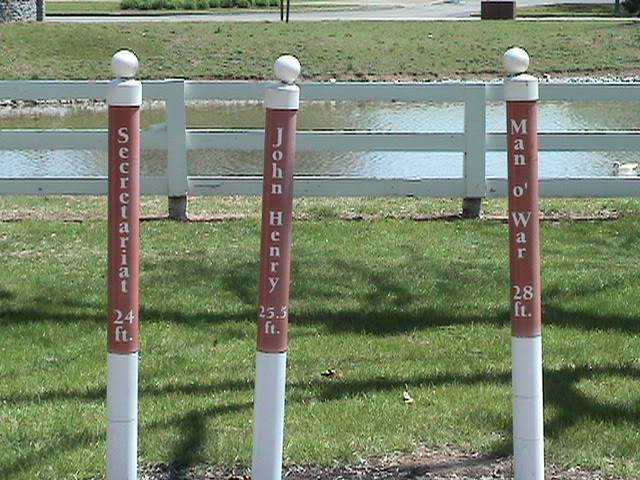
Using those points and an exponential growth curve, I got this chart:
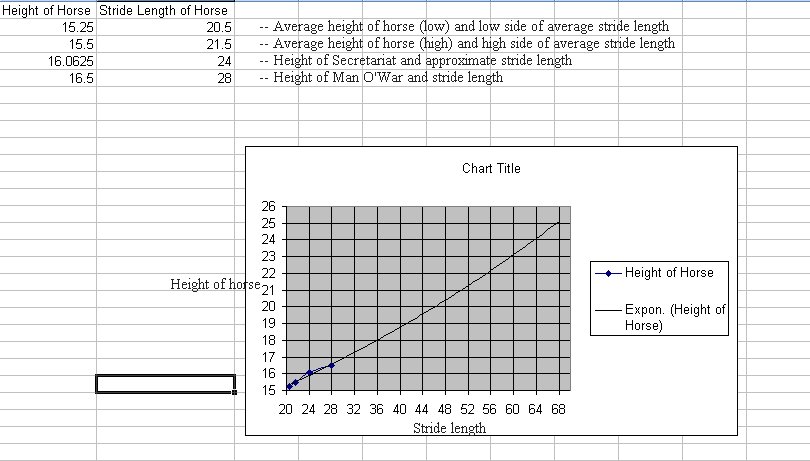
Looking at it, it appears to suggest that a horse of 24 to 25 hands should have a stride of 64 to 68 feet. I’m not sure the exponential curve is the one I want, but 68 feet seems a lot more likely than the 72 to 78 feet suggested by a linear forecast:
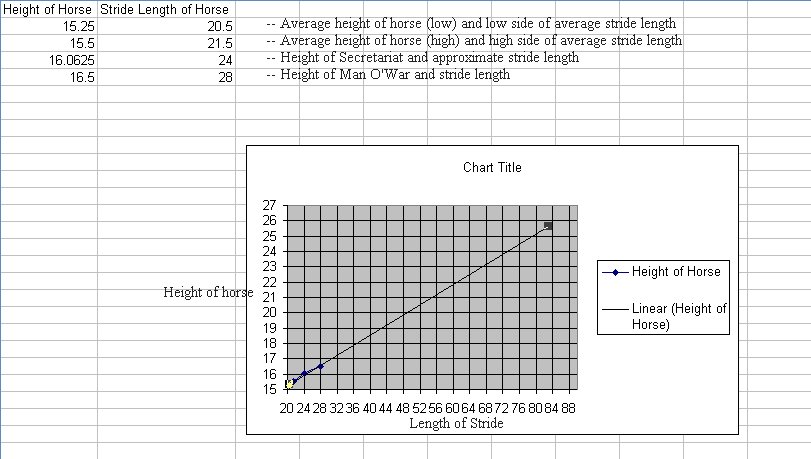
But, just for the sake of argument, let’s take the average of the two ranges, and call Morgenstern’s stride 71 feet.
According to this article, horses tend to have a stride rate of 2.25 strides/second at a gallop; looking at the race records for Secretariat and Man O’War, I calculated a stride rate of 2.31 and 1.94 strides/second, respectively. Just at a guess, using those three numbers, here’s what Morgenstern’s values would be:
- Average (2.25 str/sec):
- Feet covered in 1 second: 158.33 ft.
- Feet covered in 1 minute: 9,499.8 ft.
- Feet covered in 1 hour: 569,988 ft (107.95 miles)
- Max speed: approx. 108 miles/hour
- Secretariat (2.31 str/sec):
- Feet covered in 1 second: 164.01 ft.
- Feet covered in 1 minute: 9,840.6 ft.
- Feet covered in 1 hour: 590,436 ft (111.83 miles)
- Max speed: approx. 112 miles/hour
- Man O’War (1.94 str/sec):
- Feet covered in 1 second: 137.74 ft.
- Feet covered in 1 minute: 8,264.4 ft.
- Feet covered in 1 hour: 495,864 ft (93.91 miles)
- Max speed: approx. 94 miles/hour
If you assume a stride length of 64 feet, you still get the following values: 98 mph (average), 101 mph (Secretariat), and 85 mph (Man O’War). A stride length of 78 feet yields values of 120 mph (avg), 123 mph (Secretariat), and 103 mph (Man O’War). So I think it’s safe to say (by these calculations) that no, Morgenstern was not running at full speed when Julian chased the Mercedes through Arden, and that yes, 75 mph is well within his range of speed.
“His legs were a blur,” Corwin says – yeah, I’d say so.