
Spawned by a game in backstory mode…
Should a PC/PC backstory be public? The players involved plus the GM? Private, with a log posted for all to see later? Private, with a log sent to the GM later?
Spawned by a game in backstory mode…
Should a PC/PC backstory be public? The players involved plus the GM? Private, with a log posted for all to see later? Private, with a log sent to the GM later?
I’ve been keeping an eye on the IMC stuff as it comes around, and I usually don’t participate, mostly because I’m never quite sure what I’d say. But I can’t resist a few words on this one about Chaos.
Okay, I honestly don’t see where first- and second-series Chaos are mutually exclusive. To me, it’s all tied back to the narrators – Corwin and Merlin.
It’s a matter of wonder.
Corwin sees the wonder in things. Remember his reaction to the Unicorn? How about the woman who hands him the silver rose as he nears Chaos? Seeing Dara walk the Pattern? The drive through Arden with Random? Remember his reminiscences of Amber as he walked the Rebman Pattern? Perhaps it’s better to say that Corwin recognises the magic in the world around him.
Some of that is Corwin being a poet and composer, yes. But contrast it with Merlin.
Merlin sees the science of things. Now, don’t get me wrong – there’s wonder and magic in science. But I don’t think Merlin recognises that. Merlin only experiences wonder in a handful of situations – in Corwin’s room while Jasra questions the ty’iga in Sign of Chaos, when he calls for a horse and gets Tiger in Prince of Chaos, and once or twice when he finds Grayswandir. The rest of the time… well… Let’s just say he’s lacking in reverence and fond of the gritty details of things. “Oh, gee, look, my brother has a chapel to Brand in his closet – and he designed the entrance crappily,” Merlin essentially tells us. Or “Huh. Brand’s sword. It sounds like someone dropped holy water on a demon when I draw it. I’ll just give it to Rinaldo.”
(My boyfriend claims that Merlin’s trip through Shadow with Julia counts, but I disagree – it didn’t stay a wonder long enough. He was already regretting the experience before it was over.)
I find Merlin a dubious narrator because of his lack of wonder – his is a cold world, an analytic world, a world where clarity and simplicity are irrevocably linked. And that ties back to Chaos (wondering, weren’t you?): I think Merlin drastically oversimplified and altered his descriptions of Chaos to have it make sense to his father.
We know Merlin’s audience was Corwin – he tells us that much in the last chapter of Prince of Chaos.
We can make a reasonable guess that Merlin didn’t know Corwin very well. Yes, he heard Corwin’s entire story – but Merlin is, at best, clueless when it comes to observing the intimate details of other people’s personalities. Merlin also tells us that Corwin vanished shortly after Oberon’s funeral. I think he just didn’t have the time to get to know Corwin; there are too many moments in Merlin’s books when you can almost taste the awkwardness between the two of them (or between Merlin and Corwin’s Pattern ghost, which is funtionally the same thing).
What that leads me to is this: Merlin might think that Corwin wouldn’t understand the actual sociopolitical processes in the Courts. It’s not unlikely that he had attempted to explain to one of his aunts or uncles, and found that it was easier to relate it to something they already knew.
We know that Corwin told Merlin about the relations between the children of Oberon, so Merlin knows Corwin understands that system. Merlin could further guess that Corwin knows the monarchy systems of Shadow Earth, Avalon (which seemed close to the Amber/Earth model), and possibly Lorraine.
But Merlin couldn’t know if Corwin was familiar with any other type of monarchy system. Corwin’s Avalon is long gone, and unless he visited Lorraine, Merlin would have very little detail about that Shadow’s ruling system. How much Merlin knew about the Shadow Earth system depends on whether he had to take World History in college, whether he looked it up himself, and whether he talked to Bill about world history.
So the most sensible thing to do (to Merlin) is to relate everything in Chaos to Amber. Even if doing so means he’s grossly oversimplifying. After all, Merlin is a computer engineer, not a composer/poet. The simpler he can make a thing, the more efficient it is – and simple things have less chance of going wrong.
(Well, simple things have less chance of minor problems – they go more for the catastrophic failure route.)
(I’ll just pass up talking in-depth about how well “catastrophic failure” and Merlin go together, shall I?)
So yes, first- and second-series Chaos don’t look the same – same name to the place, but the surface and contents look different. And it’s all Merlin’s fault.
But mutually exclusive? I’m not so sure about that.
I don’t think Merlin’s tales are completely without the weirdness Corwin leads us to expect in his chronicle. Merlin gives us tiny snatches of what I’d call the true face of the Courts: the idea of the Ways, the stray currents of magic from the Abyss (see Merlin and Corwin’s Pattern ghost’s discussion when they’re trying to rescue Corwin), the pit-divers, the etiquette of shapeshifting and the dislike of the human form (Merlin and Dara’s lunch and Merlin’s confrontation with Dara and Mandor, respectively), and the wearing of red at the funeral of Swayvill. It wouldn’t be too hard to turn that small amount of information into something weird and alien without discarding the entire series.
Okay, I’m indulging in too much knowledge of horses and an urge to do math here.
“Morgenstern was six hands higher than any other horse I’d ever seen…” -Corwin (NPiA, ch. 4)
So how tall IS Morgenstern?
It depends entirely on the height of the tallest horse Corwin’s seen, and whether he was talking Earth horses or not. Let’s assume he was talking horses here on Earth; otherwise, there’s no basis to even make a guess.
The two tallest horses on record are 21.2 hands (about 7′ 2″, recorded in 1846; I’m not sure of the veracity of that particular record, since I can’t get my hands on a Guinness reference) and 19.115 hands (about 6′ 5″, recorded in the Guinness Book of Records). If Corwin saw either of these horses, it would put Morgenstern in the 25 to 27 hand height – 8′ 4″ to 9′ 0″ tall at the shoulder.
But what if he didn’t?
In that case we turn to the tallest breed of horse – the Shire. Shire horses stand taller than 16.2 hands (5′ 6″) and can be over 18 (6′ 0″) hands high. The 19.115 hand horse mentioned before was a Shire, so they’re generally under 19 hands (6′ 4″) high. Let’s assume, therefore, that the tallest horse Corwin likely saw was 18 to 19 hands high. That makes Morgenstern somewhere between 24 and 25 hands high – 8′ 0″ to 8′ 4″ at the shoulder.
Assuming Corwin was using Earth as a reference, we can probably guess that Morgenstern is 8 to 9 feet high. That is a ridiculous amount of horse.
So the next question would be how much Morgenstern weighs (well, it is for me…). I’m assuming that he’s built like a light horse – a Thoroughbred, for instance – instead of a heavy horse like a Clydesdale. I’m making this assumption based on the fact that he’s a high-speed horse, which heavy horses tend not to be; given that Julian uses him for hunting, he is also at least an adequate jumper, again something heavy horses tend to not engage in. Morgenstern is of sufficient height (as already established) that if Julian wants to engage in knightly pursuits, a heavy charger-style build is entirely unnecessary. Probably the best analogue for what I’m thinking of is a warmblooded horse like a Holsteiner:
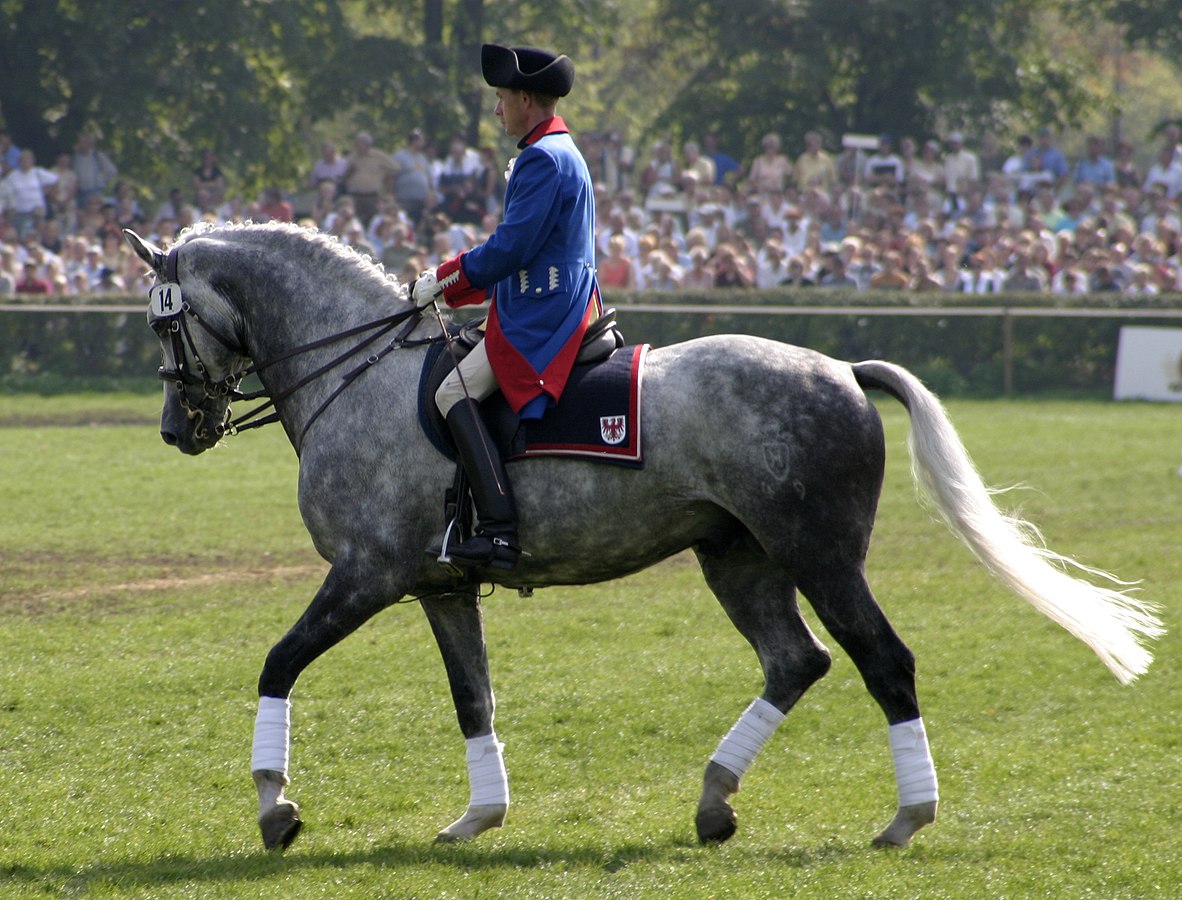
By Alexander Kastler – Own work, CC BY-SA 2.5, Link
Or a Trakhener:
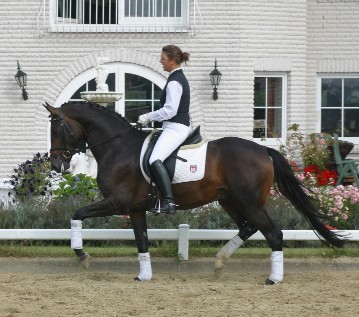
By Kleopatra4, CC BY-SA 3.0, Link
Something with the versatility of a light, hot-blooded horse (again, like a Thoroughbred) and the toughness and sturdy build of a heavy, cold-blooded horse (like the Shire or Clydesdale). (And I’m using terms like “light horse” and “hot-blooded” kind of loosely here – for an explanation, go here.)
Okay, at this point I have to go really esoteric here, so bear with me. Normally, a horse’s weight is estimated using a tape measure to measure the heartgirth (the circumference of the chest right behind the highest point of the shoulders and the elbow) and then comparing that measurement to a chart of weights. Obviously, we can’t do that in Morgenstern’s case. I only found one method of measurement that allowed one to take the height and guess the weight. It also requires a measurement of the horse’s physical condition (described here). The final guess, expanding the chart from method one of this page into this chart:
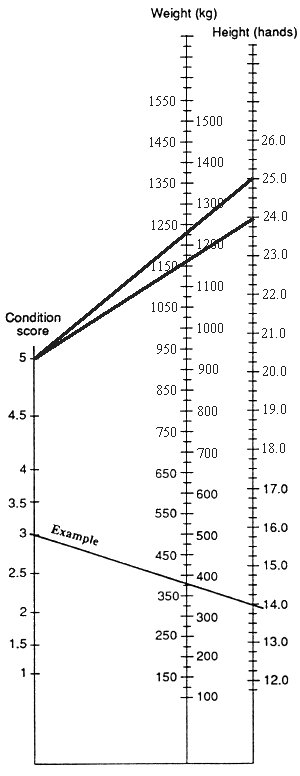
Leads me to suggest that Morgenstern would weigh at least 1150 pounds. Shire horses average around 2200 pounds; since they’re heavy horses, I hesitate to suggest that Morgenstern would be in quite the same weight class, but that might be an upper-end weight. So call him at least 1150 to 2200 pounds – around a ton of horse.
Okay, I’m finished being completely esoteric.
Looking at that again, I think my estimate for Morgenstern’s weight is WAY conservative. I just found records on Man O’War that indicate he stood 16.2 hands and weighted 1125 pounds. So I should probably revise my statement to an estimate of 1500 to 2500 pounds, at least, and possibly more.
Now on to something else that I’ve been wondering about: the kind of speed Morgenstern can produce. Corwin states that the car is traveling at around 75 mph at the point Morgenstern catches up with them – and since the horse tosses his head, I can’t believe that he’s at full speed. If you watch horses at a gallop with riders on their backs (say, in a race, or a steeplechase, or barrel racing), they never toss their heads if they’re running all-out. Random mentions that Julian was playing with them… so I doubt he was pushing for speed anyway; he had to know that the hairpin turns in the road were approaching, so there was no reason to contest the car in a straightaway. I’m going to come back to this in a moment…
Let me go a little father afield here and look at stride length.
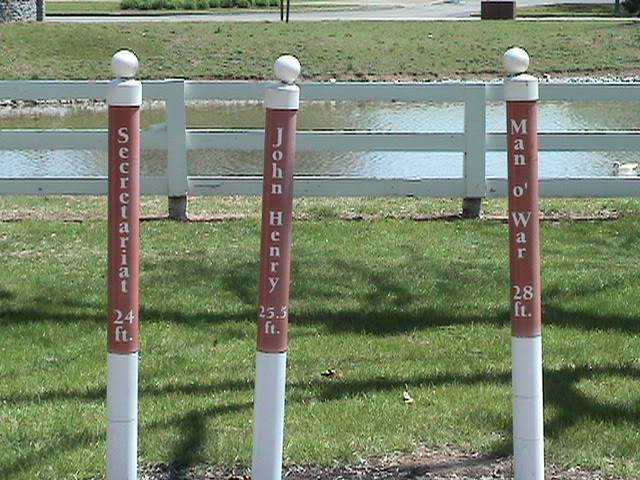
I looked up some things first. According to this .pdf (lost link), horses tend to have an average stride length of 19.5 to 22.5 feet. Average horse height is around 15.1 to 15.2 hands (5′ 1″ to 5′ 2″). To give myself a few more points, I looked at the Thoroughbred racehorses Man O’War (1917-1947; stride length is 28 feet; height as three-year-old was 16.2 hands) and Secretariat (1970-1989; stride length approx. 24 feet [inferred from
this picture, where the red/white pole farthest to the right is Man O’War’s 28-foot stride and Secretariat’s stride is marked by the red/white pole farthest to the left]; height as two-year-old was 16.025 hands):
Using those points and an exponential growth curve, I got this chart:
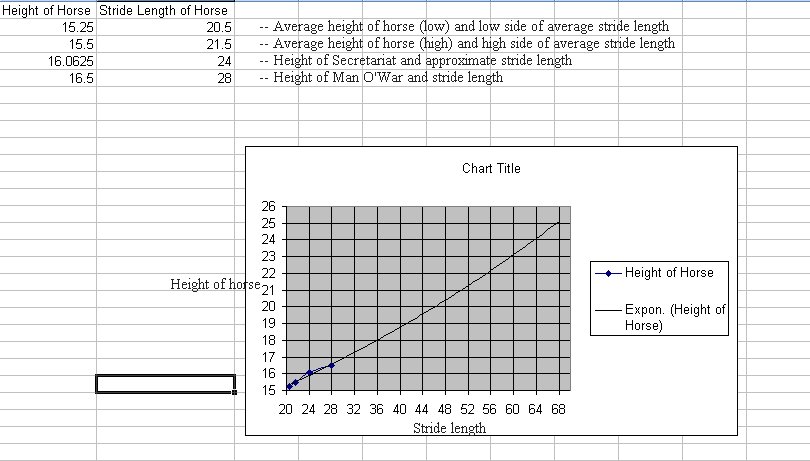
Looking at it, it appears to suggest that a horse of 24 to 25 hands should have a stride of 64 to 68 feet. I’m not sure the exponential curve is the one I want, but 68 feet seems a lot more likely than the 72 to 78 feet suggested by a linear forecast:
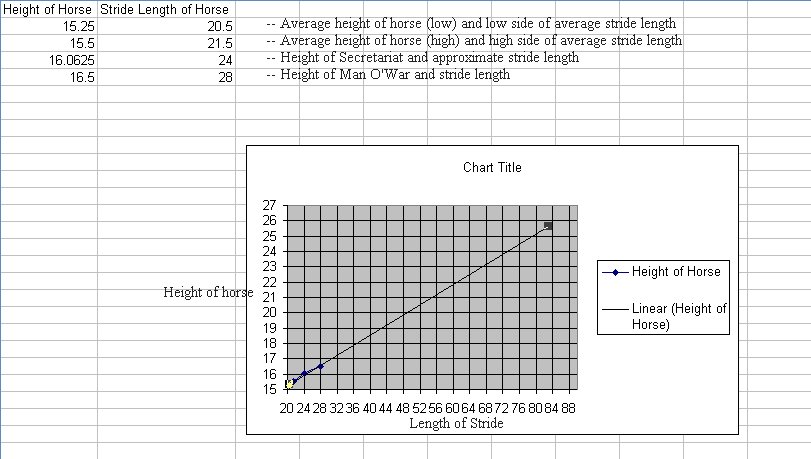
But, just for the sake of argument, let’s take the average of the two ranges, and call Morgenstern’s stride 71 feet.
According to this article, horses tend to have a stride rate of 2.25 strides/second at a gallop; looking at the race records for Secretariat and Man O’War, I calculated a stride rate of 2.31 and 1.94 strides/second, respectively. Just at a guess, using those three numbers, here’s what Morgenstern’s values would be:
If you assume a stride length of 64 feet, you still get the following values: 98 mph (average), 101 mph (Secretariat), and 85 mph (Man O’War). A stride length of 78 feet yields values of 120 mph (avg), 123 mph (Secretariat), and 103 mph (Man O’War). So I think it’s safe to say (by these calculations) that no, Morgenstern was not running at full speed when Julian chased the Mercedes through Arden, and that yes, 75 mph is well within his range of speed.
“His legs were a blur,” Corwin says – yeah, I’d say so.